Open almost any writing tool today and you’ll find a new button in the toolbar: generate. Generate a paragraph, a plot twist, a whole chapter. What began as a novelty has become a default assumption — that of course your software should write for you.
A growing number of authors want exactly the opposite. They’re looking for a writing app without AI — not out of nostalgia, but because they’ve watched what the generate button does to a draft, and to the writer holding it. Here’s why the shift is happening, what “no AI” should and shouldn’t mean, and how to choose a tool that leaves the writing to you — without giving up the features that actually help you finish a book.
The AI creep in writing tools
AI writing features rarely announce themselves as AI. First an autocomplete suggestion. Then a “continue writing” command. Then a sidebar that can outline your third act while you make coffee. Each step is framed as convenience — which is what makes it creep rather than change.
The trouble is what the temptation does to your relationship with your draft. When a stuck sentence can be delegated with one click, being stuck stops being part of the work and becomes a problem the toolbar can solve. But stuck is where the thinking happens. A novelist who outsources every hard paragraph ends up with a manuscript of plausible sentences and no fingerprints — and a skill that weakens from disuse.
Worse, the button changes the room even when you never press it. Every difficult passage now comes with a silent question: why struggle when the machine could do this in three seconds? That’s not a writing environment — it’s a negotiation you never agreed to.
Why authors are saying no
Voice is the product. Readers don’t fall in love with plots; they fall in love with the way a particular writer tells them. Voice is built sentence by sentence, over years — it’s the accumulated record of your choices, and the one thing no generator can produce. An app that writes for you is an app that writes like everyone else.
Craft is a skill you keep by using it. Writing is closer to a sport than a settings menu: the only way to stay good is to keep doing the reps. Authors who think in decades treat AI generation the way a runner treats a motorized scooter — technically faster, entirely beside the point.
Readers and contracts increasingly care. Publishers are adding AI clauses to book contracts. Magazines and contests ask submitters to certify their work is human-written. Readers swap lists of AI-free authors. Whatever you think of the technology, the market signal is clear: provenance matters now.
And underneath all of it: writing is thinking. The sentence isn’t a container for a thought you already had — it’s how you find out what the thought actually is. Outsource the sentence and you outsource the thought.
What “no AI” should still include
Choosing a writing app with no AI story generator shouldn’t mean going back to a typewriter. The line that matters isn’t help versus no help — it’s generation versus assistance.
Spellcheck has existed for decades, and nobody claims it wrote their novel. A good proofreader is a tool you control: it flags a possible issue, suggests a fix, and gets out of the way. You accept it, ignore it, or break the rule on purpose — the author has the final word. That’s assistance. It makes your writing cleaner without making it someone else’s.
Generation is different in kind, not degree. It doesn’t highlight your sentence; it replaces it. It doesn’t respect your voice; it averages a million other voices into one.
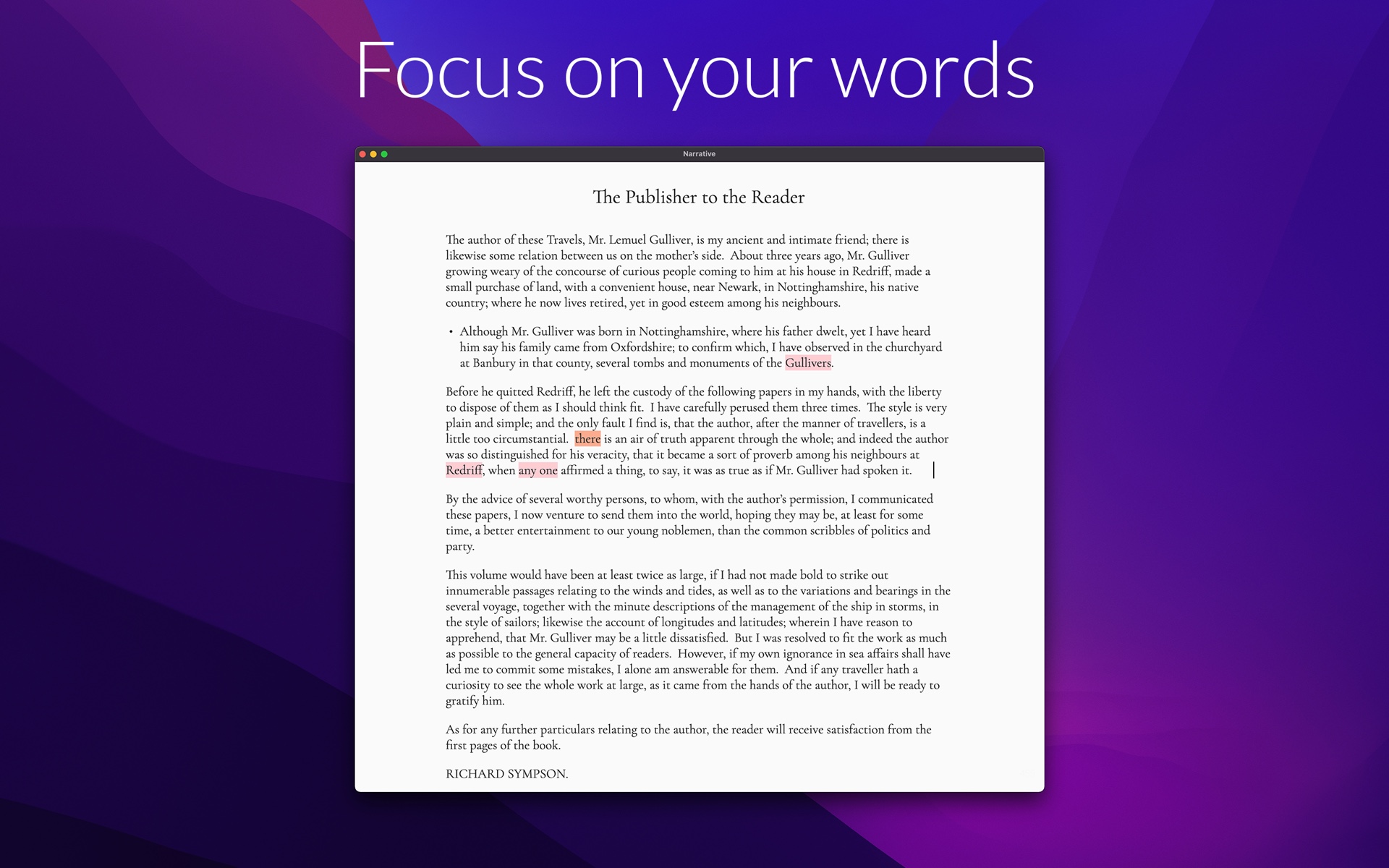
So a writing app with no AI can still include a proper proofreader — grammar, spelling and style across 12 languages, every hint toggleable. Drafting and want no commentary? Switch it off and write in silence.

Draft your novel in Narrative
Narrative is a distraction-free novel writing app: a minimalist editor with focus mode and dark mode, real-time sync across iPhone, iPad, Mac, Windows, Android and web — offline too — word count goals with daily, weekly and monthly statistics, and notes attached to your project or chapters. No AI generators: your draft stays entirely yours.
Start NowThe privacy question
There’s a second reason authors are asking harder questions about their tools, and it’s simpler than philosophy: where does my manuscript go?
In some tools, your unpublished draft is training-data bait: terms of service grant broad licenses to your text, and “may be used to improve our services.” Before you trust an app with a hundred thousand words, check two things — where your text is stored and processed, and who can read it.
Narrative’s answer is deliberately boring. Your writing lives in your private cloud account — yours, not a shared corpus. Sign out of a device and your writing is removed from it, which matters on shared machines; sign back in and it downloads fresh from the cloud. Backups are optional and go to your own Dropbox or Google Drive — a DOCX copy after every session.
A checklist for choosing a writing app without AI
Not every app that lacks AI features has a no-AI policy — sometimes the generator just hasn’t shipped yet. When you’re evaluating writing software that doesn’t use AI, look for five things:
- An explicit no-generator policy. “We don’t have AI yet” is not the same as “we never will.” Look for a public, unambiguous stance.
- Offline-capable. If the app dies without a connection, your process is hostage to your Wi-Fi. It should work offline and sync when you’re back.
- Real export formats. DOCX for your editor, EPUB for your ebook, TXT for everything else. If you can’t get your manuscript out in standard formats, you’re locked in.
- Sync you control. Your book should follow you across iPhone, iPad, Mac, Windows, Android and the web — without handing your words to anyone else along the way.
- Human support. When something goes wrong with a novel in progress, you want a person — Narrative’s in-app help is a real human, not a bot.
Write like a human, finish like a pro
Choosing a writing app without AI isn’t nostalgia — it’s a bet on the only thing that makes your book worth reading: you. The right tool protects your focus, keeps your manuscript private and portable, checks your spelling without touching your voice, and then steps aside.
Start your novel today
Free 14-day trial on every platform — fully functional, no credit card required. Unlimited access for $5/month.