Somewhere right now, a writer is attempting the same beautiful, slightly absurd challenge: draft a whole novel — call it 50,000 words — in a single month. Most people who set out to write a book don’t finish, and it’s rarely a talent problem. It’s a pacing problem.
The good news is that pacing is solvable. A word count tracker turns an overwhelming month-long mountain into a small daily decision: write today’s words, watch the bar move, repeat tomorrow. Here’s how the numbers work, why tracking works, and how to set yourself up to actually finish the draft.
The math of a draft deadline
Pick a target and a deadline and the daily number falls out of simple division. A common one — 50,000 words in 30 days — comes to 1,667 words a day. For most writers that’s about ninety focused minutes: a real effort, but not an impossible one. On day one, the number feels almost friendly.
The trouble is that word debt compounds. Skip three days and you owe 5,000 words; your daily target for the rest of the month quietly climbs past 1,850. Miss the whole first week and you’re facing roughly 2,175 words a day for twenty-three straight days. This is why so many novels die around day nine — not from one bad decision, but from a few missed days that made the next day heavier, and the day after that heavier still.
A daily target beats a monthly panic every time. “Write 50,000 words this month” is a wish. “Write 1,667 words today” is a task you can sit down and complete before dinner. Tracking is what converts the first into the second.
Why tracking your word count works
There’s a reason marathon runners wear watches instead of just “running hard.” Visible progress sustains motivation in a way willpower can’t. When you track your word count every session, the growing total becomes its own encouragement — 20,000 words in, the number itself argues that you’re the kind of person who finishes.
Streaks add momentum. Ten consecutive writing days creates something you don’t want to break, and that small daily pull gets you to the desk on the evenings when inspiration doesn’t show up.
“A bad day feels like failure; a number is just information. Data beats guilt.”
That last part matters most. If Tuesday produced 300 words, the tracker doesn’t judge — it recalculates. Guilt makes writers avoid the page; numbers make them adjust the plan. That difference decides more finished drafts than prose style ever will.
Set up your project the right way
Do the organizing before you start drafting, so the writing itself can be pure drafting:
One project for the novel. Everything you write lives in one place, so your count is always honest and your chapters are always findable. Set a word count goal on the project. Watching a progress bar cross 50%, then 75%, does more for morale than any pep talk. Attach notes now, not mid-draft. Plot outlines, character sketches, world details — keep them as notes next to the project or the chapter you’re drafting, so a forgotten eye color never costs you a writing session.
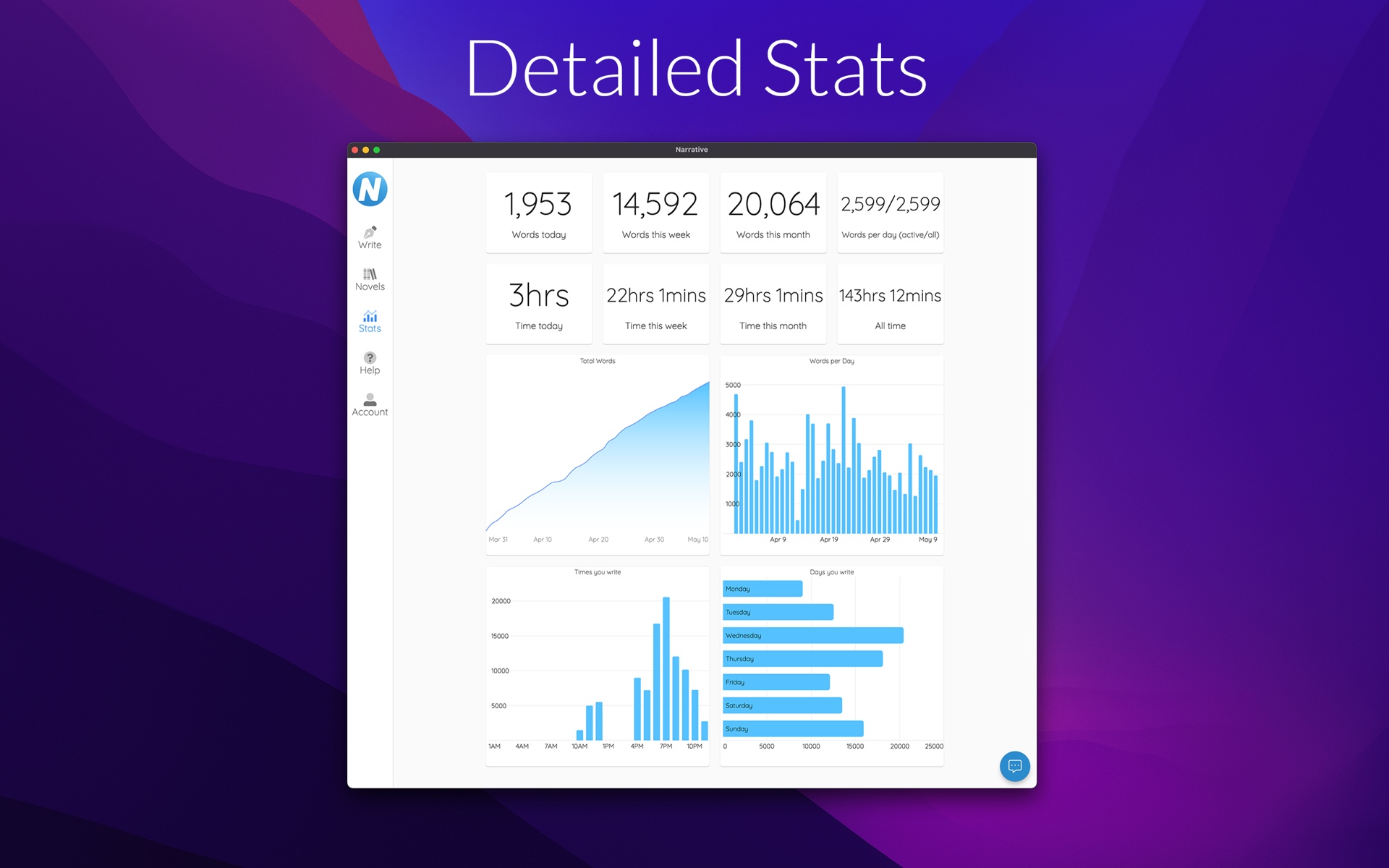
This is where the right tool pays for itself. Narrative lets you set a word count goal per project, then quietly tracks your daily, weekly, monthly and all-time word counts — plus the time you spend writing — so the pace math above happens automatically while you draft.

Draft your novel in Narrative
Narrative is a distraction-free novel writing app: a minimalist editor with focus mode and dark mode, real-time sync across iPhone, iPad, Mac, Windows, Android and web — offline too — word count goals with daily, weekly and monthly statistics, and notes attached to your project or chapters. No AI generators: your draft stays entirely yours.
Start NowFind your most productive hours
A month of tracking reveals something most writers have never actually seen: when they write best. Maybe your Tuesday evenings produce twice the words of your Saturday mornings. Maybe you’re secretly a 6 a.m. writer who has been fighting your own biology for years.
Narrative’s writing statistics chart your words per day alongside the days and hours you’re most productive, so after a week you can stop guessing. Schedule your hardest sprints inside your proven best windows and save the shallow hours for notes and admin. A word count tracker doesn’t just get you to the finish line — it teaches you how you work.
How to recover from a bad week
It will happen: work explodes, someone gets sick, and four days vanish. The worst response is panic-writing every spare minute until you burn out. Try this instead:
- Recalculate, don’t despair. Divide your remaining words by the remaining days. A 5,000-word deficit at the halfway mark raises your daily target from 1,667 to about 2,000 — uncomfortable, but doable.
- Book two big catch-up sessions. Two long weekend sessions beat seven days of anxious nibbling. Clear a Sunday morning, write 3,000 words, and the math looks friendly again.
- Protect one sacred writing hour. Pick the hour your charts say you write best, put it in the calendar, and treat it like a flight you can’t miss. Most things can slip; that hour can’t.
- Log every session, even the bad ones. Watching the recalculated daily target drop back toward 1,667 is the fastest way to believe the comeback is real.
Past the finish line: keep the streak alive
Here’s the secret every finisher learns: the target was the excuse. The habit is the real prize. A month of tracked, daily writing rewires how you think about your book — it stops being a someday project and becomes a thing you do at 7 a.m. with coffee.
So don’t stop when you hit the number. Keep tracking into revision: daily counts still motivate when you’re rewriting chapters, and time-spent-writing stats keep you honest when editing makes the word count wobble. When the draft is truly ready, export it — Narrative exports DOCX, TXT and EPUB — and send it to your editor, your beta readers, or your future self.
Start tracking today
Drafts get finished by writers who know their number and hit it one day at a time. Set your word count goal, write today’s 1,667, and let the tracker carry the motivation. Behind on your own deadline? Start anyway — a word count goal works from whatever day you set it.
Start your novel today
Free 14-day trial on every platform — fully functional, no credit card required. Unlimited access for $5/month.