Here is the secret every published author had to learn for themselves: writing a novel is a process, not a gift. It is a series of stages — idea, habit, draft, revision, proofreading — and each stage has its own skills. None of them requires genius. All of them can be learned.
You do not need an MFA, a cabin in the woods, or a year off work. To write your first novel you need an idea that will not leave you alone, a habit you can actually keep, and a way to see your progress. Let’s start where every novel starts.
Start with an idea you can’t stop thinking about
First-time novelists often believe they need a complete plot before they begin. You don’t. You need a premise: a “what if” you can’t stop turning over. What if a woman discovers her late husband’s novels were all written by someone else? What if the last library on Earth opens only at night? A plot is how the story unfolds; a premise is why you can’t let it go — and you will be living with yours for a year or more, so choose the one that survives contact with your daily life.
Before you commit, test it. Write the premise down and leave it alone for two weeks. If it still sparks when you come back — if new scenes keep arriving uninvited while you’re doing the dishes — you have your novel.
From day one, keep a notes habit. Fragments of dialogue, character details, a name you overheard on the train: capture everything in one place, attached to the book it belongs to. In Narrative you can attach notes to the whole project or to individual chapters, so your ideas and research live right next to the page instead of in a separate app you’ll forget to open.
Build a daily writing habit that actually sticks
Most first novels die the same death: a heroic weekend of five thousand words, then three weeks of nothing, then guilt, then abandonment. Inspiration is unreliable; arithmetic is not. Five hundred words a day — about forty focused minutes — adds up to roughly 90,000 words in six months. That is a full-length novel draft, written in the margins of an ordinary life.
Make the goal small enough that you can’t say no, and anchor it to something fixed: same time, same place, same cup of coffee. A daily word count goal turns “write a book” — a terrifying, shapeless ambition — into “write 500 words before dinner,” which is merely Tuesday. Small goals you hit every day will always beat large goals you hit once a month.
Writing software with word count goals helps here: set your target, let the app do the counting, and spend your energy on the words themselves.
Write your first draft without editing
The single most important skill in how to write a novel is learning to separate drafting from judging. Your inner editor wants every sentence perfect before you move on. Obey it, and you will spend six months polishing chapter one while the other twenty-nine chapters never get written.
A first draft has only one job: to exist.
Give yourself permission to be bad. Write the scene clumsily. Use the placeholder name. Leave “[fight scene goes here]” and move on. Momentum matters more than elegance at this stage, because you cannot revise a blank page — and everything in a first draft can be fixed later.
It also helps to draft in a distraction-free environment. A focus mode that fades out everything except your words removes the temptation to fiddle with formatting, answer notifications, or endlessly re-read yesterday’s pages instead of writing today’s.

Draft your novel in Narrative
Narrative is a distraction-free novel writing app: a minimalist editor with focus mode and dark mode, real-time sync across iPhone, iPad, Mac, Windows, Android and web — offline too — word count goals with daily, weekly and monthly statistics, and notes attached to your project or chapters. No AI generators: your draft stays entirely yours.
Start NowTrack your progress
A novel is too big to finish on motivation alone. What carries you through the muddy middle is evidence: proof that the book is growing even on the days it doesn’t feel like it.
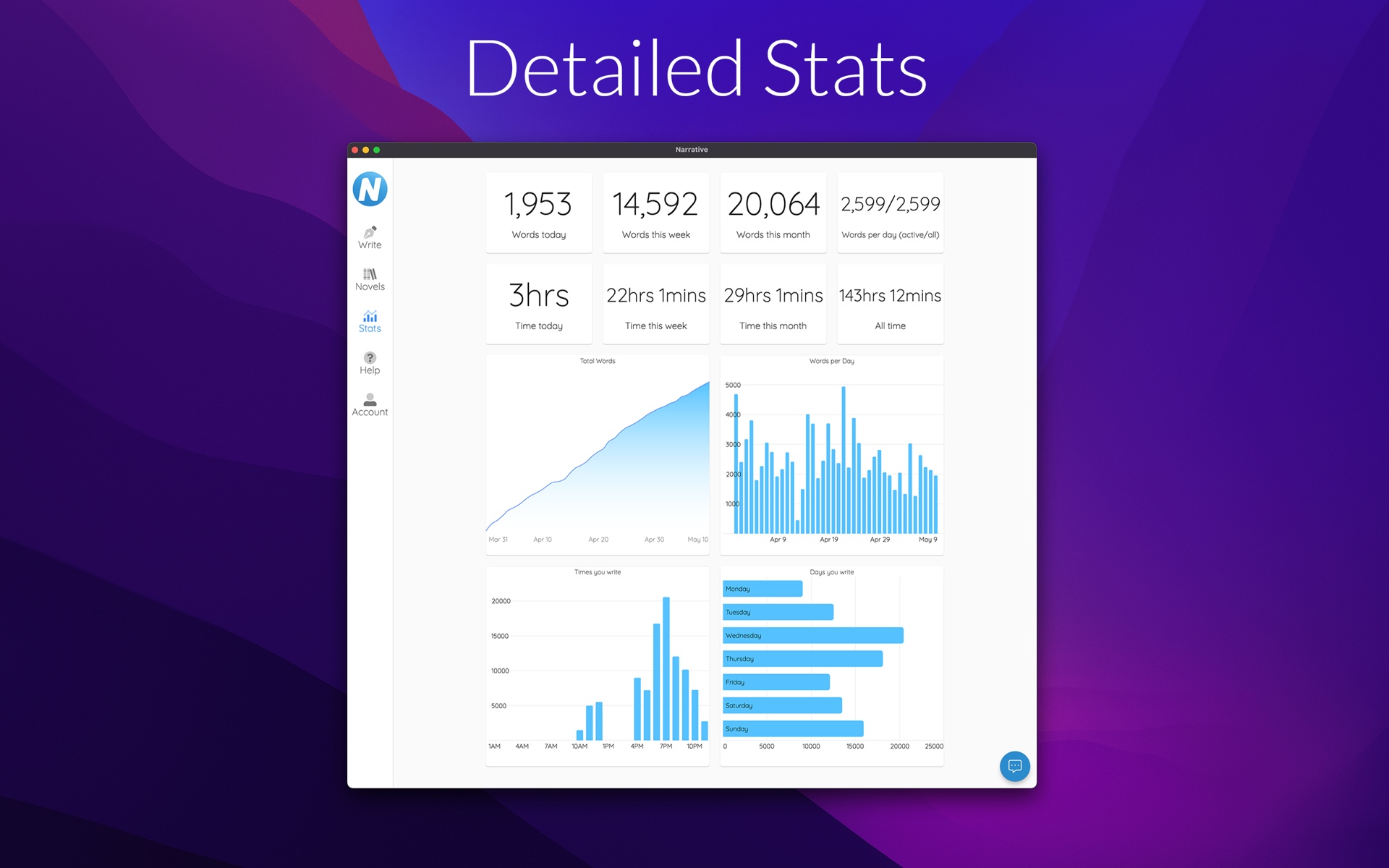
So track your words. Watching a daily word count tick upward, a streak extend, a chart fill in — these are small, steady rewards for showing up. Narrative’s writing statistics show your words per day, week and month, plus the days and hours you’re most productive, so you can schedule sessions for when your brain actually cooperates. It’s motivation without gamification: no badges, no pressure, just the quiet satisfaction of a number that only goes up.
Revise in passes, not all at once
When you type “The End,” celebrate — then close the document. Distance comes first: give the draft at least two weeks, ideally a month. You need to read it as a stranger would, and strangers don’t remember what you meant to write.
Then revise in passes, one problem at a time:
- Story pass. Does the plot hold together? Do character arcs land? Cut, move or rewrite whole chapters here — big structural surgery always comes before any polishing.
- Style pass. Now the prose: voice, pacing, dialogue, sentence rhythm. Read passages aloud; your ear catches what your eye misses.
- Mechanics pass. Only now grammar, spelling and punctuation. Fixing commas in a scene you’ll later delete is work you’ll do twice.
Proofread, then share it
The final mechanics pass is where tools genuinely help. Your eyes auto-correct your own typos; software doesn’t. Narrative’s proofreader checks grammar, spelling and style in 12 languages and dialects — and it suggests rather than rewrites, so your voice stays intact. For a full method, read our guide on how to proofread your own novel.
Then let other humans in. Beta readers and editors need files they can actually open: export your manuscript to DOCX for editors and EPUB for e-readers — our step-by-step guide to exporting your novel to EPUB walks you through it. Narrative also imports DOCX and TXT, so you can bring an existing work-in-progress with you and pick up exactly where you left off.
Your first chapter starts today
Every published novel began as someone’s uncertain first page. The difference between aspiring novelists and finished ones isn’t talent — it’s that the finished ones kept going after it stopped being fun, one ordinary session at a time.
You now know how to write a novel: premise, habit, draft, revision, proofread, share. The only step left is the first one. Open a new document, write your first chapter today — and finish your draft the same way, 500 words at a time.
Start your novel today
Free 14-day trial on every platform — fully functional, no credit card required. Unlimited access for $5/month.